I put a working facial recognition and license plate tracking system online. I call it lechuza, and it runs on cameras at my home in New Orleans. Anyone can browse what it captures at lechuza.perdidoinstitute.com.
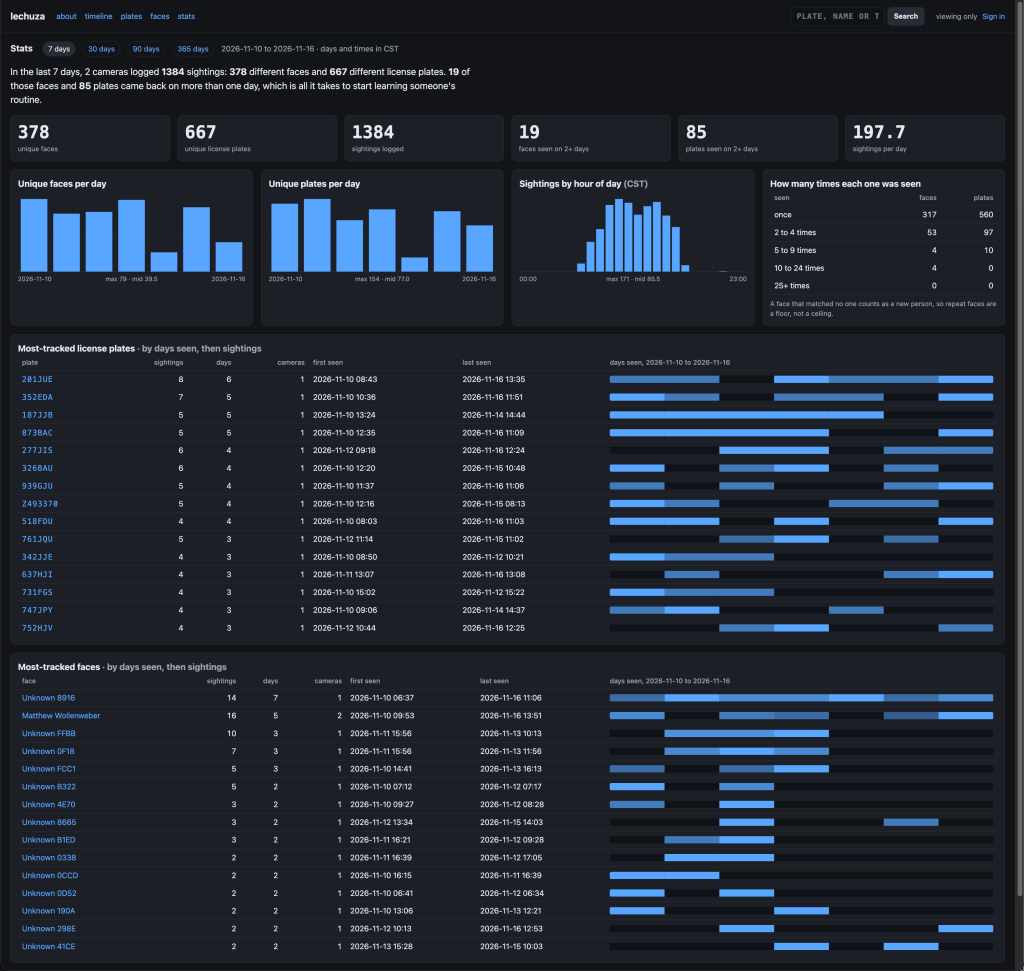
In 11 days, two cameras at one house logged 1,848 sightings of 507 faces and 873 license plates, the site’s stats page reported on November 16, 2026.
I have spent years writing and talking about facial recognition and automated license plate readers in New Orleans. Talking only goes so far, because the ideas stay abstract. Until you see a real surveillance system, a camera sounds like one more person watching the street. Facial recognition is software that matches faces in a video feed against faces it has seen before. An automated license plate reader is software that reads a license plate from an image and stores it as searchable text.
A camera is not the same as a person. A passerby sees you once and forgets. Surveillance logs each sighting, ties it to a face or a plate, stores it, and makes it searchable. Browse lechuza and you see how the police, ICE, and private spy corporations like Project NOLA track you.
A list of faces and plates with times attached reads like the notes of a stalker who writes down every time you leave the house.
The view is ordinary. The record is Orwellian.
The front gate camera sees what anyone standing in my front yard can see: a public street, the cars on it, and the people who walk by. Nothing in that view is private.
The software changes what the view produces. It reads each license plate into text and logs it with the time. It measures each face, compares it with faces it has already seen, and files repeat sightings under one label, such as “Unknown FFBB.”
The site shows still images and the time of every sighting. It does not show video.
A neighbor walking a dog becomes a record. A week of walks becomes a pattern.
The 1,848 sightings start on November 6, the date of the oldest sighting still in the system. A face the software cannot match counts as a new one, so the 507 faces may include some people more than once. Over those 11 days, lechuza logged 33 of the faces and 109 of the plates on more than one day, according to the stats page.
I am one of the people it tracks, and lechuza keeps a page tracking me.
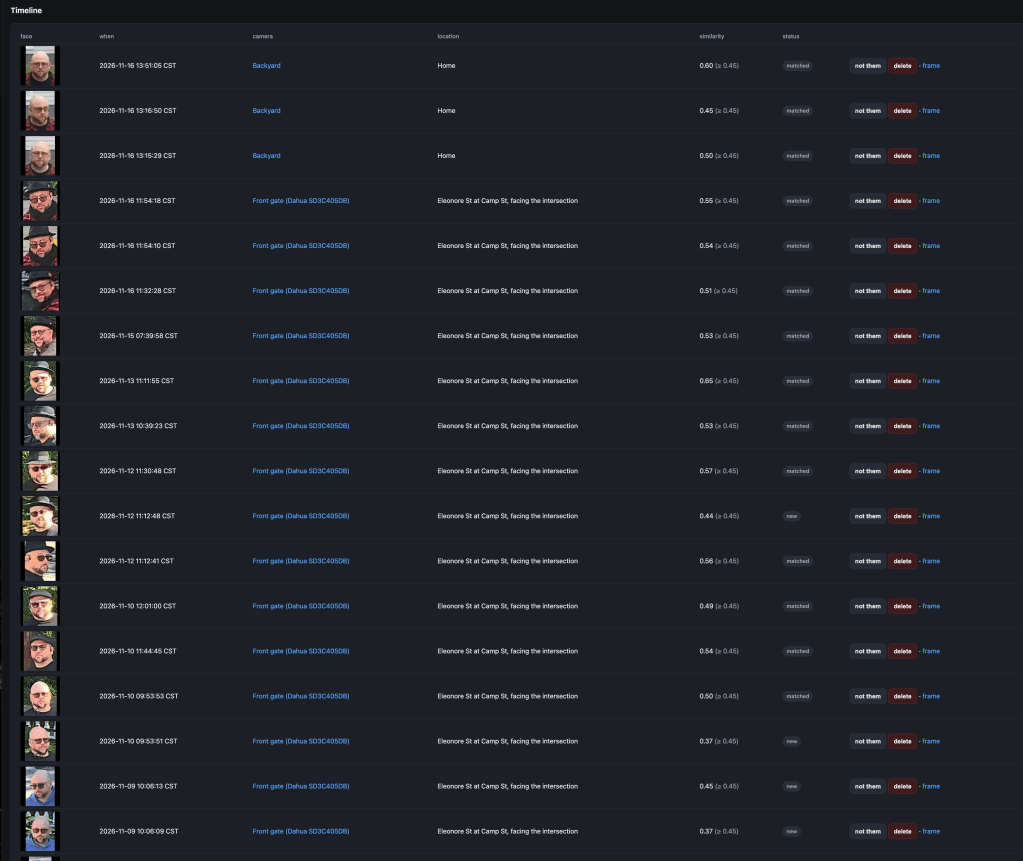
Between November 9 and November 16, it logged my face 19 times over six days, on both cameras: the one at my front gate and the one in my backyard. Eighteen of those sightings fell between 9:53 a.m. and 1:51 p.m.
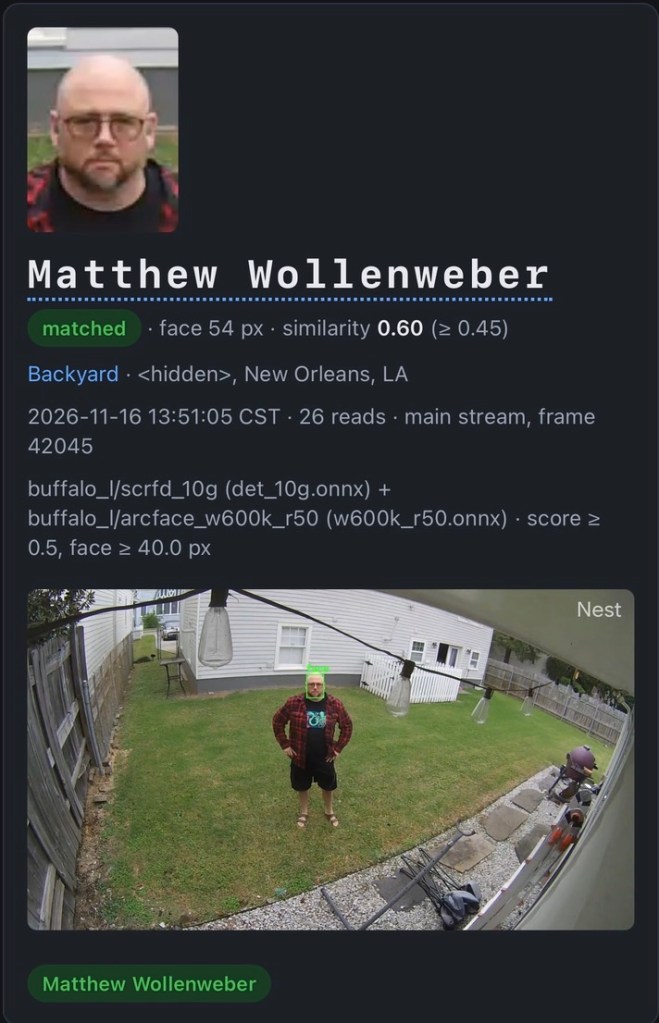
The page lists each sighting with the time, the camera, a link to the full frame, and a match score, the software’s rating of how closely the face resembles mine. Ten reference pictures of my face, which the software uses to recognize me, are set to never expire. A week of entries is enough to guess when I am usually home and when I go outside.
Anyone can visit without an account. Browse the timeline, the plates, and the faces for a few minutes. A street I see every day becomes a searchable list of people and cars.
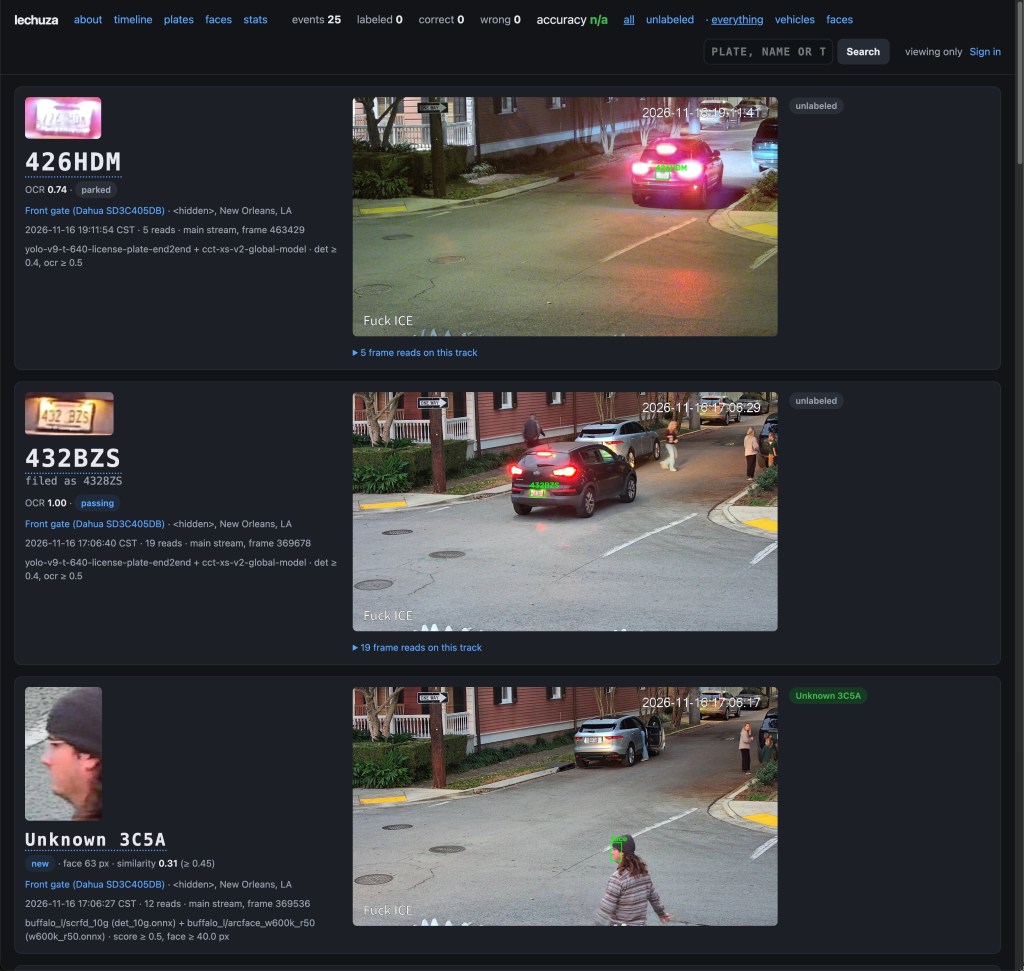
The cameras have no facial recognition or plate reader. The software adds both.
My cameras have no built-in facial recognition and no built-in plate reader. Each camera streams video, and a video stream is all lechuza needs.
The recognition happens off the camera, in software I wrote that uses AI models to find and compare faces and to read plates. That software adds facial recognition and plate reading to almost any camera that can stream video.
The capability lives in the software behind the camera. Whoever receives a video stream decides what software reads it, and nothing on the camera has to change.
Governments and corporations have added facial recognition and plate reading to video streams for years. It is one of the reasons fusion centers exist: they are hubs where agencies pool and analyze intelligence.
Project NOLA’s video already reaches the state’s facial recognition hub.
Project NOLA is a private spy corporation that collects video from more than 5,000 cameras mounted on private property, NPR reported in December 2025. Project NOLA added live facial recognition in 2022, and about 200 of its cameras have it, according to the same report. Its video management software, DSS Pro, comes from Dahua, the company that made my front gate camera, and supports both facial recognition and plate recognition.
Project NOLA passes that video to law enforcement. Prism reported that in a September 2025 Facebook post, Project NOLA said it shares live feeds with local and state agencies, including Louisiana State Police.
State Police also run facial recognition for the New Orleans Police Department (NOPD). As of June 2025, NOPD policy required officers to submit facial recognition requests to State Police through the Louisiana State Analytical and Fusion Exchange (LA-SAFE), Biometric Update reported. LA-SAFE is the state fusion center. Project NOLA and other camera systems stream video to LA-SAFE.
My cameras have no facial recognition, yet lechuza identifies faces and reads plates from their video. Almost any camera that streams works the same way. A camera with no facial recognition on the box tells you nothing about what happens to its video after it leaves. The roughly 4,800 Project NOLA cameras without live facial recognition only need to stream.
I built lechuza alone. Two cameras at one house logged 507 faces and 873 plates in 11 days. Project NOLA collects video from more than 5,000 cameras, and the agencies that receive that video can do what lechuza does, at scale.
Surveillance like this is not benign. We should not accept it. Sign the petition to stop surveillance in New Orleans and share it with someone who lives here.

